
In a default Kubernetes cluster, any pod can reach your database
Kubernetes pod networking is flat by default. How NetworkPolicies lock it down, a default-deny pattern that's easy to reason about, and the selector trap everyone hits once.

Out of the box, a Kubernetes pod network is flat. Every pod can open a connection to every other pod, in every namespace. That includes your database, and it includes whatever compromised pod an attacker just landed in.
NetworkPolicies fix this. They're a firewall for pods, written with labels instead of IP addresses, and they're one of the cheapest security wins in Kubernetes.
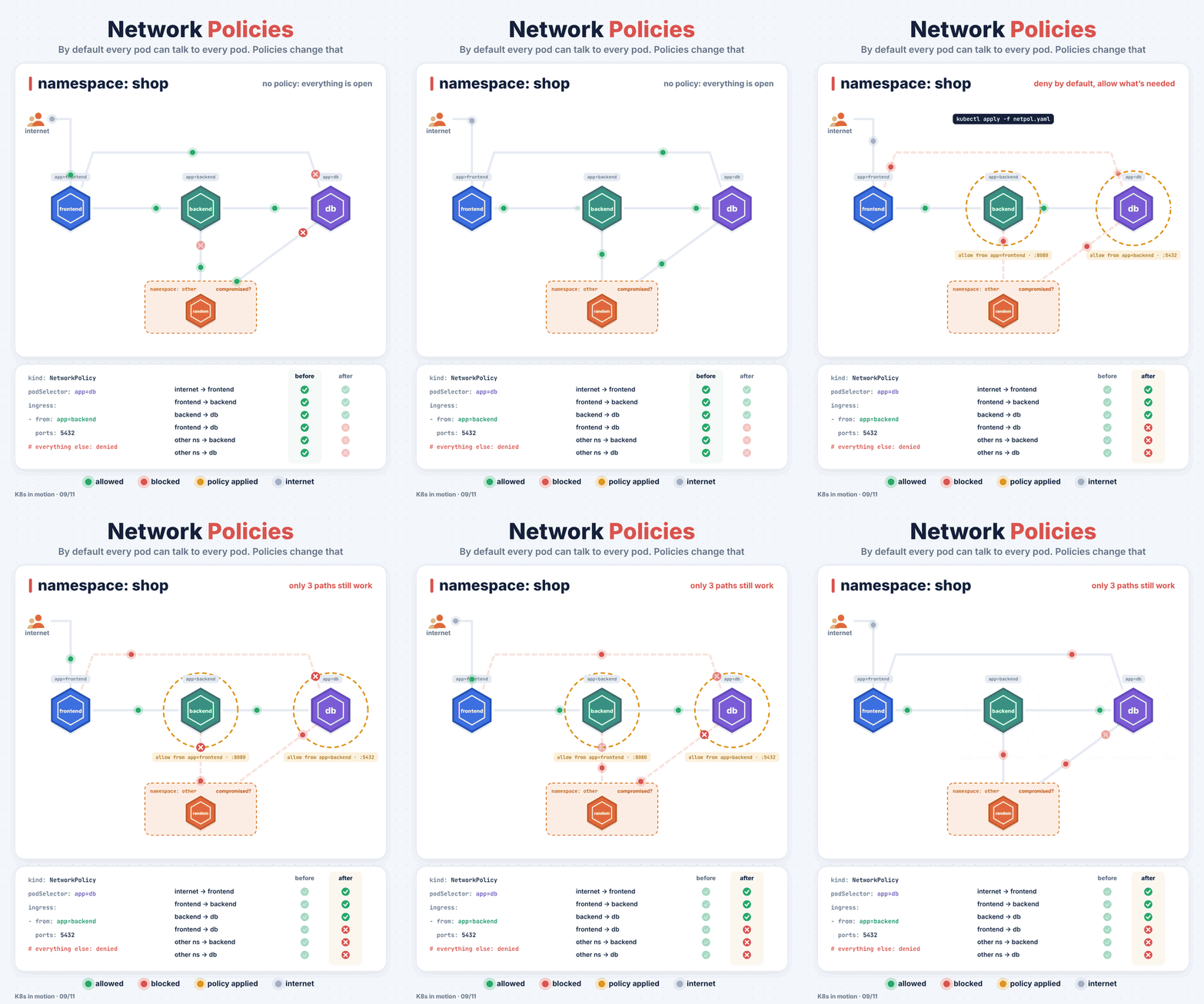
Before and after
Before: internet to frontend to backend to db works. So do frontend straight to db, and a pod in some other namespace straight to db. Nobody asked for those last two.
After two policies, only the three paths you need still work. Everything else is dropped at the pod.
The two policies
Only backend may talk to db, and only on Postgres:
apiVersion: networking.k8s.io/v1
kind: NetworkPolicy
metadata:
  name: db-from-backend
  namespace: shop
spec:
  podSelector:
    matchLabels: { app: db }
  policyTypes: [Ingress]
  ingress:
    - from:
        - podSelector:
            matchLabels: { app: backend }
      ports:
        - port: 5432
The backend policy looks the same, allowing app: frontend on port 8080.
Start with default deny
Writing allow rules pod by pod gets confusing fast. A cleaner pattern is to deny everything in a namespace first, then add exactly what you need:
apiVersion: networking.k8s.io/v1
kind: NetworkPolicy
metadata:
  name: default-deny-ingress
  namespace: shop
spec:
  podSelector: {}
  policyTypes: [Ingress]
An empty podSelector selects every pod in the namespace. With no ingress rules, nothing gets in. Now every allowed path in the namespace is one you wrote down on purpose, which makes reviews much easier.
Things that trip people up
- Your CNI has to enforce them. Calico, Cilium, the AWS VPC CNI's network policy agent, Azure's and GKE's built-in options all do. Some basic setups accept the objects and silently ignore them. Test with a pod that shouldn't connect.
- Once any policy selects a pod, the default flips. For that direction (ingress or egress), everything not explicitly allowed is denied.
- Egress lockdown breaks DNS. If you add
EgresstopolicyTypes, allow UDP and TCP port 53 tokube-dns, or nothing will resolve and every error will look like a networking bug. - The AND vs OR trap. This is the one that gets everyone once:
# AND: pods labelled app=backend IN namespaces labelled team=shop
- from:
    - namespaceSelector: { matchLabels: { team: shop } }
      podSelector: { matchLabels: { app: backend } }

# OR: ANY pod in team=shop namespaces, OR app=backend pods in this namespace
- from:
    - namespaceSelector: { matchLabels: { team: shop } }
    - podSelector: { matchLabels: { app: backend } }
One dash makes the difference. The second version is much wider than it looks.
Test it
# Should print BLOCKED once the policies are applied
kubectl run probe --rm -it --image=busybox -n shop -l app=frontend -- \
  sh -c 'nc -w 3 db 5432 </dev/null && echo CONNECTED || echo BLOCKED'
If that connection still succeeds, check whether your CNI enforces policies before you check the YAML.